Showing posts with label lawrence miles. Show all posts

2014-11-23

CHAOS MARXISM: Final Communique?

Remember the Faction Paradox mythos? A bunch of renegades in masks, causing havoc for the Masters of Reality, by their very existence thumbing their nose at what gives those Lords of Time and Space their power? Whatever happened to Lawrence Miles' glorious dream?

What's that you say, Eddie Blake?

"It came true. You're looking at it."

Let's just adjust the picture slightly:
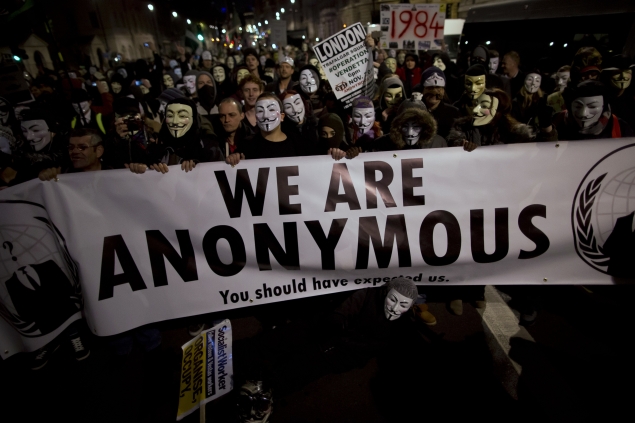
There. Now we're looking at it.
Alan Moore knows the score, and he knows exactly how the Masked (Wo)Man is such an ambiguous figure. And certainly, mass-produced stylized Guy Fawkes masks aren't nearly as cool as the Faction's bad-ass "time-travelling space goth" get-up.

My very best friend in the world used to dream about actually having a Paradox caucus - in full get-up, mind you - in our country's parliament. But I pointed out to her: in their mythos, the reason that the Faction's masks terrify the rulers of reality is that they are made from the skulls of creatures who never existed. The power of these Time Lords Great Houses is based on the fact that they own history and nothing changes in it without their say-so, that cause always follows effect. Those masks strike at everything they hold dear.

Obviously that's not going to terrify members of the actually existing ruling classes of Earth. What will? Used to be the Red Flag or the Circle-A of course - back in the 20s, when bosses would keep worker uniforms in their closet in case the revolution came and they had to sneak out undetected. But that's pretty much kitsch these days. How many workers in advanced capitalist countries use either hammers or sickles these days?

But you know what actually-existing late globalised postmodern consumerist capitalism needs, beyond everything else? Two things that increasingly it becomes clear that it can't live with out. The obvious one: secrecy. Government secrecy, trade secrecy, the walls of secrecy (enforced and culturally appropriate) which prevents us comparing our lots, raising our consciousness, getting organised, etc.

The less obvious one, and here's where the psychological/spiritual side of CM comes in: identity. The Conspiracy (to use SubGenius lingo) needs you to be you. It needs you to have a forename, a hindname, and an address - an individuality - by which it "interpellates" you into the system (to use Althusser's great word). It needs you to be predictable. It needs you to have a place within the system.

Buddhists and Sufis have long said that identity - or ego - is the main barrier to enlightenment. Not, we hasten to add, having an "I" - but being attached to it, and the social rights and responsibilities which it maintains, and all the pleasures of participating in culture. It's said that a true Master would be equally happy as a king or a CEO, or begging for spare change outside a convenience store. Of course, those are tricks for advanced players.

The Anonymous mask - and this is what's beautiful - was totally historically contingent. Firstly, we had to have the otherwise disappoint Wachowski film of V for Vendetta, with its final scene of - rather than Evey taking on V's mask herself - a massed army of V's converging on Parliament. Secondly, we had the fact that Anonymous' first campaign was against Scientology - known to track down and harrass its critics. Wearing interchangeable masks was simply self defence.

(Speaking of which, dumbasses like to point out that every time someone buys a V mask, someone at DC Comics / Warner Bros makes money. This is a dumb point because there is no outside to commodity culture. You cannot live outside the cash-nexus any more, and anyone who tries is a moralist hippie or otherwise irrelevant to the struggle. You can only hope to transform it by conscious action - by using the rope the capitalist sells you to hang him with. Plus, some schmuck in Shenzhen or wherever has a steady job making those masks.)

The proletariat - the working class - isn't part of the system. That's why workers have no place in late capitalist culture - they want you to define yourself by the cultural goods you buy or the prefab subculture (with or without its own economy) you get into in your spare time. It's the Lacanian Real, the Horror Behind Door #3, the Face behind the Mask which is in fact just another Mask, it is the shit of the System which is the only thing which can transform the System. Barring total civilisational collapse, hostile UFOs or the Second Coming, of course.

The trap is of course that "revolutionary", in the dried-up remnants of 1968, has become just another identity-based subculture that capitalism sells back to you. Some clever Frenchmen worked this out in 1974, so why has it taken so long for anyone to notice? For the same reason that Maurice Brinton predicted the degeneration and collapse of the British SWP 30 years before it happened.

AND... because most people like it that way. It's most common in anarchism - or at least was, when I read some Alexander Berkman in the mid-90s and started going to meetings of my local anarcho group. I didn't wear patched clothing, wasn't a vegan, and didn't (then) like hardcore punk. So what was the point? It was a nice subculture and not a cult, but it wasn't revolutionary politics. Thank you once again, Out To Lunch, for showing me a glimpse of what revolutionary politics means for artists and other mad people.

So: being a revolutionary is much, much harder than joining a revolutionary group and being an active member. Panagiotis Sotiris asks the absolutely vital question: how can we change the world if we can't change ourselves? To be a true revolutionary, Chaos Marxism suggests, is very similar to being a Buddhist monk on the road to enlightenment. You have to be prepared to throw everything overboard, including "you". And including your "street cred" within "the movement". Including that precious Party/League/Group/Org you spent 30 years building!!!

Hazrat-e-Pir Dr. Javad Nurbakhsh said that the true sign of a Master is that 1000 truthful witnesses can be found to declare him a charlatan, a heretic, a corrupt bullshit artist, and a turkey (or similar phrases). If you're not being cast out by polite society, you're not doing it right. Assuming that what you wanted to be was the instrument through which change can come from within to this $2.99 Material World-As-Is.

I am not sure I can sum up any better than the above what I've learned in 27 years exploring my psyche, 12 years as a Marxist revolutionary, and probably a couple of months as an actual human being, so I may end there.

2011-04-01

However did it come to this?

"A failed initiation doesn't mean the end of all things, but it means that any future attempts will be even less likely to succeed." - Lawrence Miles

"No god accepted me; no power spoke through me; no-one came to get me out. The suffering was meaningless." - from my personal diary

2010-04-16

It seems like ages since I quoted Mad Larry

... there's a difference between "left-wing" and "liberal". To be a liberal means to believe that tolerance is good and global warming is bad, but also to believe that you can save the world simply by not using the word "poof". S/he may have good intentions, but doesn't seem to appreciate that all the things s/he considers to be civilised - democracy, universal suffrage, the right to exist without having the shit kicked out of you for having long hair or skin that's a bit on the dark side - were achieved through the effort of rather more pro-active people, who fought and occasionally died in order to create a less appalling version of humanity. To be a liberal means to shield yourself from the full horror of your society, to have a veneer of civic responsibility while still approving of a system that's wholly founded on exploitation.

And this is why political activism is still necessary - because what freedoms the vast majority have were only ever won by active rebellion. I fear that an increasing proportion of liberals - among which I count most of the people who read blogs like this - are all for a global system of slave-labour and oppression, as long as they're part of the 15% privileged slaves who live in fancy cages with internet access and don't get physically whipped.

2010-01-08

A couple of thoughts...

One by Llewellen Vaughan Lee:

What the wayfarer does not initially understand is that the real work on the path is not to have access to spiritual or mystical experiences: these are given through grace. The work is to create a container for them, so they can be alive in our daily life. Part of this container is to discriminate between a real inner experience and a spiritual illusion created by the ego. Without a container or discrimination the wayfarer easily becomes lost and wastes the energy and potential of her awakening.

To put it another way - the goal is not to get metaphysically high. That's far too easy. Certainly you can eat a few mushrooms, chant and breathe in unnatural ways or even hit your head against the wall and you'll see God, or something that is trying to look like God at least. The goal is to bring something useful back from that Other World into the Real World of Horrible Jobs. As Robert Fripp puts it, you can take the elevator up to the penthouse on special occasions, but you cannot afford to pay the rent to actually live there - except if you've been saving up for a long, long time.

Another important point from above is that you don't call the Spirits. The spirits call you. The best you can do is prepare yourself so you're at least at home and awake when the Ulterior World comes knocking. All the truly great spiritual masters have a truly astounding level of humility - coupled with a wicked sense of humour.

And an original thought: the rebirth of the polytheistic nature religions in the mid-to-late capitalist era has, I feel, far less to do with a reassertion of collective unconscious or the awakening of the Goddess, than the cultural fragmentation brought on by the consumer era. Monotheistic religion suggests a tightly organised Creation supervised by an ineffable but essentially benevolent God. Polytheistic religion suggests a confusing jumble of spiritual powers, spirits, loa etc. all feuding with one another - to tap into the world of Lawrence Miles for a moment, there's a War in Heaven and humans are going to get caught in the crossfire if they don't make powerful friends among the various Godfathers. Welcome to life in the era of mass media saturation.

But Marxism agrees with the mystical monotheisms in that it's all a unity behind the scenes. The various Brands which stalk our cultural landscape like alien gods are not real - when the Muslims say that shirk is the gravest sin, what they mean is by bowing down and giving your soul-energy to a cultural phantasm. Of course, you can create your own Brand, your own cult, your own small god, carve out a little niche in the World-As-Is where you can enjoy the illusion of your separate existence and your Special Snowflake status. But all power ultimately rests in the willingness or otherwise of the working class to allow their labour to be exploited. All those phantoms will disappear when we as a class discover the magic word. It's our destiny as a species.

ETA: speaking of Fripp, here's a good article.

2009-07-15

Non sola scriptura

The hallmark of braindead fundamentalism is literalism. For those of you who haven't had the pleasure of both sides of the story, arguing with braindead Marxists is very similar to arguing with braindead Christians - only the name of the scripture has changed. Epistle to the Hebrews on one side, What is to be done? on the other. Argument by quotation is especially stupid when the source matter contradicts itself - Lenin, as I think I've said elsewhere, was a very good politician and changed his mind on a regular basis when a more convincing hypothesis came past, so anything you find him saying you can find him saying the opposite elsewhere.

You can learn neither magick nor revolutionary politics from a book, any more than you can learn to play violin or do aikido. Only by personal experience - gnosis. And the only book you can get gnosis from is a book of poetry, or other literary art - that is, something that conveys an extra message behind its surface meaning, in its very words, shape, and method of transition, that can only be experienced by the subtle and animal sense rather than the logical brain.

So - all "religious scripture", in the real sense of the term, has to include poetry. A reasonably pure example of this is the Qur'an, based on the refusal of authority to any translation, which means that there's something special about the language of the original classical Arabic. It could just be that it's excellent poetry in the sense that Robert Graves would understand, and recitation in the original brings about specific and predictable psychic events. Some Muslim scholars - operating of course on the belief that it's a direct transmission from Universe Central - have even suggested that it's like the art of the Great Houses in the fiction of Lawrence Miles, in that it is designed to change its meaning and its effect a couple of millennia down the track. Some people make similar claims for the King James version of the bible, even though its translation is crap, its poetry is pretty damn impressive - to the point where people think it's a distinct and superior revelation to the Greek and Hebrew originals. And let me put it right here that all the great Marxists were great writers in the artistic sense of the term.

If art is intimately related to gnosis, one way you can tell who the monsters are is the quality of their art, presuming of course that art is objective. Someone once suggested that the difference between Trotsky and Stalin's writings is the difference between a clear mountain stream and a sewage outfall. You can say similar things about Mein Kampf, or anything by L. Ron Hubbard. Crowley was by some regards a great poet, although your mileage might vary. And the poetry of Ezra Pound retains its power despite the fact that the author was a fascist scumbag. Trust the tale, not the teller - truth is truth whether it comes from the mouth of a saintly prophet, a drunken bum, Michael Jackson, or someone disingenously hiding behind a pseudonym. All real, useful, bone-level truth comes from the same Source, common to all of us.

2009-02-26

*ronch* *ronch* *ronch*

I think Alan Moore is a pretty cool guy. Eh is serious about magick for the masses and doesn't afraid of anything:

There is the Bumper Book of Magic, which I am working on with my friend and inspiration Steve Moore—no relation. We are hoping that when we get it finished, in probably a couple of years, that it will be the most lucid, most beautiful, and probably most informative and funny grimoire that anybody has ever produced. It will be the first time a book of this nature, a huge compendium of magic which explains it in theory, in practice, which explains its history, and which includes all sorts of other wonderful features—it will be the first time this has ever been done for a mass market.

All of the previous magicians who've published grimoires have done it for an esoteric elite, and it's mainly been done in fairly opaque language that would only be comprehensible to people with already a fair amount of arcane knowledge. What we are trying to do is to make this, as I say, completely lucid, to demystify it, and at the same time to restore it to the position of reverence that we think that it should be in.


This is a venture entirely in congruence with the principles of Chaos Marxism. Of course, we want to construct an open-source wiki-style grimoire for the new millennium, but I can't blame Old Beardy for taking every opportunity presented, by the release of a movie he never wanted produced, to try something a bit different and daring.

(DISCLAIMER: I am going to see Watchmen and I fully expect to love it to death, because I'm one of those shallow zombies incapable of real thought who Alan and Mad Larry are always going on about.)

2007-10-11

"True... from a certain point of view."

People who pose as "modernist" or "Enlightenment" giggle and guffaw at "pre-rational" ways of understanding the world. How, they ask, could Amazon tribes, or even the cultured citizens of the Roman Republic, believe that their stories about gods and superheroes and monsters were actually true?

Perhaps there are several values of "true". I remember arguing with a serious Christian (back in my Wiccan-missionary phase, which I cringe to remember), who said to me something like: "Do you think I'm stupid? I don't believe snakes can talk. But I believe the Genesis narrative is morally true."

Perhaps we can generalise that the mythic-life of a culture is seen by its participants as "true on a moral level". What happens in the stories which hold a culture together doesn't have to actually make sense by the physical laws of the universe or the social laws of behaviour, as long as it makes moral or narrative or symbolic sense. Even if we believe the Gods are real on some level, we don't expect them to behave by human rules.

To give this a concrete modern context: it is generally recognized that the whole "War on Terror" / Iraq occupation is not being fought on the rules of ordinary human reality. Previous wars had to be fought that way because if you lost, the enemy would actually occupy your country, steal all your food and sexually abuse your loved ones. But the worst that will happen to "the West" is a humilation and a loss of global bragging rights. In terms that Mad Larry would understand, it is a war for cultural and historical space.

Orwell had it right: when the State can wage war without fear to its own survival, it is under no obligation to actually pursue the war in a rational way. All it has to do is keep fighting, because the war is not about survival, but about being right, and in that case the goal is not to occupy territory or seize resources (although these are both part of a complete breakfast), but to generate the correct images. The images which will ensure that citizens of the "free West" continue to believe (on a "moral level") that their States (and the corporates behind them) are essentially benevolent and all-powerful, and that the only alternative is a blasphemous darkness and irrationality. As for those outside the state, as Caligula put it - "Oderint dum metuant", let them hate us as long as they fear us.

It does not seem too great an assumption that ordinary people see what they see on TV and hear in their cultural sphere as morally, not literally or physically true. They expect to hear from their TV news not hard facts, but stories which resonate with the ideas they have in their own heads about how the world operates - and they will not think to question narratives which have what Stephen Colbert calls "truthiness". The most important of these narratives is: "Our governments and bosses are the good guys, and I can ignore the horrible bits of life if I can feel I am on the right side in the great struggle for Truth, Justice and the (Insert my country here) Way." (Because if people didn't willingly believe that, in the absence of a credible alternative myth-for-life, life for many would be without obvious hope altogether.)

Accordingly - after 9/11, what you heard was "we had to do something" - not because it would bring 3000 New Yorkers back from the grave or prevent more deaths, but to restore the image that bad things like that didn't happen to the enlightened, prosperous good guys. See here for an analysis of what this meant in America (and to a lesser degree elsewhere) - a McCarthyist witchhunt of people who actually wanted to explain why people might restort to terrorism. People who wanted the war to make physical, concrete sense were indeed traitors - traitors to the essential myths of our society. How dare you hold the Gods of our Tribe to your laws of pathetic human reality, you reality-based community unbelievers?

The purpose of the War on Terror is exactly the same as the purpose of the Cold War - to cow all foreign and domestic opposition to capitalist imperialism, and provide an ideological justification for imperialism abroad and clawbacks on political and social liberties at home. It is being won to the extent that the official media-godforms (the enlightened West brings salvation to lesser countries with laser-guided bombs, and you can either cheerlead for it or be crushed as an Islamofascist or a "Crazy") continue to grab hold of the popular imagination.

But the point is that these myths are not based on stupid physical or social reality, but on the moral truths which bind our allegiance to the State and the corporations for which it stands. And as such, they have to be fought on that level. The corporate egregore [life-form created by belief] will stop existing the instant that the masses stop believing in it. Only a win for our side on the ideological/cultural field - a succesful "alternative life-myth" which seizes the masses - will make the elected politicians cut off funding, or encourage the troops to mutiny. (The Iraqi resistance understand this when they try to create their own media weapons.)

The movement against war - which is the movement against corporate imperialism - has to create our own myths, godforms, stories and icons. These will have to be based in messy physical everyday reality - only when you have a truckload of lawyers, guns and wage-slave labour can you just decide what you want to be true and make it so. Which will mean training ourselves to be able to tell what actually is real, what's not real, and what's the difference - which, in many cases, will mean throwing out the cherished myths which make up our membership of the Tribe of the Free, Enlightened West.

2007-09-17

Closer now, to seeing the revelation

I have a recurring dream where I have finally been accepted into the S00per-Sekrit Society of Cool People Who Are The Only Hope For The World. Their headquarters is up a set of clammy and portentous stone steps, and they have the damndest best parties up there. Everyone is extremely pretty and wants to have sex with me once we get back from our vital, world-changing missions.

And then I wake up and say "...stupid reality."


And that's what most really popular fiction is, it's lying to the target audience, it's coming up with whatever they need to hear to make them feel good about themselves. It's about reassuring them that they're the centre of the universe. I know I'm well-known for ranting, but I think that's the thing which unites everything I've ever ranted against. Sandman and The Matrix and Harry Potter all have it in common, they're all incredibly cynical that way, they're all about the self-satisfaction of the audience. They're about making people in the target demographic group feel as if they're the chosen ones, or potential chosen ones.


- Mad Larry. In "This Town", Larry also says something along the lines of "the only true witch is someone who understands that there are no cosmic forces". Well, the 15 year old me who read The Mists of Avalon and believed it for a while might be happy to hear that.

2007-08-29

A link, a valedictory, two observations and a grumble

LINK: A bunch of trolls cogently suggest a materialist viewpoint, although I'd disagree with their overestimation of the extent to which an "ordinary person" can tell what's material reality.

VALEDICTORY: The Beasthouse is closing down. Mad Larry says to copy and paste all the good bits ASAP, and who are we to argue with Grandfather Paradox his own self?

OBSERVATION (1): The "living goddesses" of India bear a striking and important resemblance to the movie stars of Hollywood, in the way that they embody cultural archetypes but only so long as they are hedged about with all manner of taboos. (Of course, the difference is that when a Hollywood star breaks the taboos, if they do it enough they can turn into cultural demons rather than gods, as Mss. Hilton and Lohan demonstrate.

OBSERVATION (2): You want to know what a cultural archetype is? Look at what people turn up to costume parties dressed as. Sometimes these are actual people - Marilyn Monroe, Bela Lugosi and Tor Johnson can testify.

GRUMBLE: I know full well I promised some guest postings a month or three ago. What happened to those? Y'know, I'm kind of wondering that myself.

2007-07-12

Larry and Doloras sitting in a tree

Traditionally, though, the most useful way of understanding the meaning of "right-wing" has been to look at what people who classify themselves as right-wing have in common.... But this model of the universe has broken down, now that most left-wingers are equally tedious. So perhaps the only true indicator of a human being, in our supposedly-busy but monumentally lazy civilisation, is self-obsession. If you're entirely hung up on your own "lifestyle", whether you think you're a small-l liberal or a small-c conservative [or, indeed, a socialist, anarchist or magickian - DlaP], then you're right-wing. If you're so concerned with the vestments of that lifestyle that you lose sight of anything else, so determined to surround yourself with a fortress of The Right Kind of Stuff that you're incapable of thinking beyond your own self-image, then you're filling the same niche in society that used to be occupied by old-school bunker-mentality Tories. Because civilisation isn't about sealing yourself off from the rest of the world and your responsibility to it, and you don't get bonus marks just for being tolerant towards homosexuals or not using the word "piccaninnies".


See? It's not just me who thinks so. Lifestyles, demographics and nichemarkets are the modern enemy of consciousness.

Thoughts on rereading the Communist Manifesto and Faction Paradox at the same time

The major difference between now and Marx's time (apart from globalisation having advanced to the extent he foresaw) is that it's no longer true that capitalism bases itself entirely on the cash nexus and brute force. The commodification of all human existence led to consumer capitalism, where the mass of the working class have to buy the products that are produced. Capitalism destroyed all the old myths, but then had to create new myths to continually expand consumption and win our consent to the system. It's no accident that psychology was born at the same time as mass consumer society and universal suffrage. Psychology was born because it was useful to try to manufacture our consent and get us to consume.

All citizens of an advanced capitalist state are socialised as consumers and citizens as well as workers. The mass media is used to socialise docile obedient and exploitable workers, and citizens who identify with "their" state, and at the same time wild, crazy and independent consumers. The marketing industries induce wants and needs which can only be satisfied by consumption, or to dress the psychic wounds left by alienation in the workplace. If your job sucks, you get to have retail therapy, or pay to be pampered by a service worker. One side of the apparatus says TERRORISE, the other BENEVOLISE, at the same time. This is what we call a contradiction.

Consuming a good or service is explicitly intended to fill psychic gaps. Consumers pay for the burying and disavowal of labour - not just the sign of people working, but the signs that their goods or services are brought to them by other human beings. The promise of the market economy is that workers are your own "personal slave", with no thought except your pleasure. This is what you get for your money (which is usually earned by *you* having to take your turn in the barrel, so to speak). As Zizek says - everyone knows this isn't literally true, but acts like it's true, and are angry and disappointed when the facade isn't kept up. Note also that in modern capitalism needs healthy, well-fed, educated and skilled workers, so it can't starve us, which means we've crawled up Maslow's hierarchy of needs a ways.

This is one of the reasons state capitalism fell over. Not faced with cutthroat competition, their propaganda apparatus fell way behind that of the bourgeois capitalist countries. The West looked desirable not because of freedom but because of consumer goods. (Of course, this wasn't just appearance - Western consumer goods *were* better, for all the reasons that Tony Cliff explained, plus in the 80's the growth of a true global market.)

Propaganda - both aimed at feelings of citizenship or consumerism - is increasingly filling the cap in the apparatus of social control and manufacturing consent that organised religion used to. Of course, there are "bottom up" ways that people fill these gaps - with subcultures, etc - but even those end up being harnessed to sell more products. Lawrence Miles is 100% correct that the biggest problem with modern consumer culture is that the arts of marketing have advanced to the point where demographic categories have a stranglehold over any mass media culture which gets released. A subculture which does not put itself in opposition to the system quickly becomes a demographic category (hippy, punk, sci-fi nerd, fetishist, goth, etc) and thus incorporated. Ben Watson, too, has noticed that "community" has come to mean "marketing category" in modern jargon.

Members of a demographic category are not in a position to revolt. "The proletariat" is not a product of the demographic-category machine. It's like an evil waste product that corrodes the system from the inside. At least potentially.

2007-07-06

You know me. Prepare to die.

Hmph. No saucers again?

Anyway, the big news is that this blog is about to be kickstarted into life with a series of guest contributions. I won't spoil the surprise of who or what just yet, but I will undertake to act as a bit of a "warm-up act", to make sure you're still watching.

Longtime readers may know that I am impressed by the work of the sci-fi author Lawrence Miles - although perhaps less because of his work (mindfuckingly good as it is in places), but because the kind of things he says in interviews and blogs come off as extremely similar to a lot of the basic ideas behind Chaos Marxism. Unfortunately the site which used to archive his interviews has fallen victim to a time paradox, but behold the magic of intarwebz necromancy! Have a good browse.

I want to point out one of the most interesting ideas that come out of his Faction Paradox mythos. In this mythos based around time travel, all of humanity's history is featured, from the australopithecines to the "post-human" civilisations that will exist after Earth and its sun are no more and beyond. In the entry from The Book of the War on "Humanity", Larry (I think it's him, anyway) explains that in this timeline, just about now, in the early 21st century, (the "Ghost Point" of human history), all human cultural progression stops, and then begins to go backward. At one level this is supposed to explain why science fiction futures always look like, as Douglas Adams puts it, "the present with faster cars and smellier air". But it's also a representation of how the dominant culture thinks. To quote Marx: for the bourgeoisie, history was something that used to happened but has now thankfully stopped, with the right people in charge. If anyone paid me for it, I could write a very interesting Marxist analysis of the place of the Time Lords in the Doctor Who and related mythoses.

In any case, Larry in his other articles rants and raves about what he sees as this closing down of human potential that he sees all around him in the stultification and conformity of the mass media. He's no Marxist - he's a consistent and principled left-liberal who has not become reconciled to the victory of neo-liberalism but can't see any way out of the predicament. I hear his later work This Town Will Never Let Us Go is an extended meditation on these themes, and I may have to write about it.

If Chaos Marxism has any real point, it is to make sure that the Ghost Point is not allowed to happen. Well, of course, it wouldn't, because (given current science and human nature) you could never have a static society, or even one which gradually fell to bits over a long period. The choices are still socialism or barbarism. To quote another, more naive Doctor Who spin-off, "The 21st century is where it all starts." Or, alternatively, stops.

A parting thought - the reason most of this isn't written down in book or academic article form yet is pretty much that I don't want to be one of those wankerish "Marxist cultural commentators" who make a living pointing out the class relations of the lifeboat crew as the Titanic is going down. When Chaos Marxism is presented in for-the-masses form, it will be as a how-to guide. "101 Things An Enterprising Cultural Revolutionary Can Do To Seriously Fuck Things Up, As Opposed To Creating A Niche Market So You Can Buy A Flash Hybrid Car", or something like that. I want this to be eminently practical, and I get frustrated that I haven't got results that would stand up to peer-reviewed scrutiny yet. But I am working on it.

2007-02-11

Mad Larry gets close to the truth

On Meddling

Most of our culture’s problems are the fault of marketing, or at the very least, they’re the fault of people who think they’re marketing but are actually just making everyone miserable. I’ve already argued that “’political correctness’” – a phrase which deserves a double set of inverted commas, for reasons I’ve gone into at length [28/12/06] – is mainly the invention of paranoid right-wingers rather than interfering liberal do-gooders, but it is true that somebody, somewhere, is doing an awful lot of meddling. Guns are edited out of old movies, violence is surgically excised from cartoons, scripts are rewritten so that female characters are always shown to be strong, flawless and self-willed (much to the annoyance of actresses, who know that characters with enormous personality defects are vastly more interesting) while black characters are shown to be capable of unlimited compassion / redemption (much to the annoyance of black actors, who like playing villains with eyepatches as much as anyone else does).

This isn’t the work of “’political correctness’”, and it certainly isn’t the work of anybody remotely left-wing. It’s the work of the executive class, of corporate committees, of armies of marketing consultants and commando squadrons of research analysts. Their meddling isn’t done for political reasons, or indeed for the sake of any agenda at all, apart from the obvious profit-related one. Put too much violence in a family programme, and a minority of parents will complain, damaging ratings and losing advertising revenue. Make a movie in which the bad guys are “ethnic”, and members of that ethnic group might not pay to see it. Actual political correctness exists in marketing rather than in ideology, and essentially means doing whatever’s necessary in order to appeal to the widest possible demographic: “demographically correct” might be a better term, although I’ve tried using it in conversation and it never catches on. If we lived in a world where 98% of the population belonged to the Ku Klux Klan, then it’d be a safe bet that exactly the same people who now make sure there’s a positive “ethnic” character in every Hollywood movie would make sure there's always a big black cannibal with a bone through his nose instead.

Our political system has exactly the same problem as our culture, and for exactly the same reasons. Most people still assume that in a general election, the major parties will campaign to get as many votes from the general public as possible, but this is no longer true. The major parties know full well that most demographic groups are guaranteed to vote for a specific party no matter what the candidates do, and that there’s no point campaigning for the support of anybody except those in the middle-ground, the small minority which might still swing either way. All three of Britain’s leading parties now use the same “targeting software” to identify these key groups, and to work out what those groups want. And the “targeting software” is telling them all exactly the same thing: focus on middle-class consumers with expendable income, people to whom the outcome of an election doesn’t particularly matter. This is why the most recent election manifestos of all three leading parties have been indistinguishable apart from the adjectives, and even Howard’s arse-waffle about asylum-seekers masked a policy barely any different to Blair’s. In effect, Britain is no longer a democratic society, and it wouldn’t be democratic even if we weren’t under American jurisdiction. Because what we’ve learned over the last ten years – if we didn’t already instinctively know it – is that marketing and democracy are incompatible. Whether it’s in Hollywood or Westminster, marketing means a blanding-out, a removal of any significant difference on the grounds that it might offend one type of consumer-voter or another. Choice, actual choice rather than the consumer kind, can’t exist without difference. And democracy, like culture itself, relies on choice.

Is this the real tragedy of what happened to us in the late 1970s? I’ve already argued that the last thirty years of Western history have largely been about the triumph of self-obsession [06/12/06], but perhaps the biggest single problem is that by favouring “personal lifestyle choices” instead of “society”, we’ve put far too much power into the hands of the marketing specialists. Let’s not forget, Ronald Reagan was the first world leader to be elected because his advisors focused on lifestyles rather than issues. The aforementioned targeting software works on the same principle, encouraging politicians to concentrate on “what do people in Harrogate do with their leisure time?” rather than “how do we formulate an ethical foreign policy?”. The upshot is that we’ve ended up with a society which isn’t just dangerously complacent and politically bankrupt, but also very, very dull. If you went back in time and told my eight-year-old self that he’d grow up in a world where people have pocket-sized computers and you can access almost any piece of information on Earth from a box in your bedroom, then I don’t think he would have believed it could be so mediocre.


You can read more of the demented and occasionally scarily insightful ramblings of the creator of Faction Paradox here. (Please ignore the ignorant, hateful nonsense about transsexual people, though.)

2007-01-23

Mad Larry sometimes gets it right

It was, incidentally, S Club Seven who made it clear what's wrong with engineered pop: it works like Stalinism, which means it's dull by definition.


(Who's Mad Larry, I hear you ask?)

2007-01-22

Memetics 101

Consciousness is changed via practice - you are what you do. "Brainwashing" the passive brain is impossible. The most effective advertising does not say "Brand X has qualities Y and Z"; instead, it presents a meme which associates X with Y and Z and leaves it up to the recipients to connect the dots. All the best "cult" literature, art and popular narrative - the most virally infective memes, to use another metaphor - require that the readers/viewers/listeners do some work to make some sense of what they are given.

For some years I have practiced - on and off - a meditative/cognitive-self-help practice known as UCP. It can be boiled down to systematically comparing present reality to places in your memory and your imagination. Once again, the crucial part is to compare and contrast - do some mental work - rather than to just passively observe.

So, Rule One for wannabe memetic engineers: leave some holes in your propaganda. Leave it to the recipients to make the connections that you are pointing towards. This opens the possibility of misinterpretation, but it ensures that it will actually get a hook into the cognitive processes of the target audience.

Rule Two would, of course, be leave it open source - "proprietary" belief systems only work in a capitalist system where their propagators have a truckload of money to replicate their ideas via brute force. On the other hand, if you've got no money, you have to attract collaborators, not employees. Example: Lovecraft not only incorporated other's ideas (Carcosa, Hastur etc.) into his mythos, but actively encouraged others to join in - hence the Cthulhu Mythos has grown virally. (I think perhaps Larry Miles is trying to do something similar with Faction Paradox.)

Rule Three, as Uncle Al knew, is of course invoke often.

2006-10-03

Metaphors bite

If there needs to be some kind of sober, feet-on-the-ground, I'm-a-simple-railway-worker-mate-I-don't-understand-this-cultural-studies-crap excuse for this blog, let's put it like this: metaphorical, narrative language can help people understand real although intangible forces better than intellectual jargon.

Case in point: the horror novel Wetbones by John Shirley (original screenwriter for The Crow and follower of "Bob"), 1993. The article by the author linked to above explains one of the major themes of the book - it explains addiction and the personality damage caused by addiction in terms of invisible monsters which feed on pain and degradation - and in terms of people who serve these invisible monsters. Interestingly enough, we're not only talking about chemical addiction here - we're talking about emotional dependance and abusive relationships, on the personal and on the personality-cult level.

(As an aside, the infallible litmus test of whether an organisation is a cult or just a bunch of idiots is whether initative is accepted and praised, or whether intellectual and/or emotional dependence in a leader or a leadership clique is encouraged. In other words, the difference between proletarian-activist and pettybourgeois-moralist-religious consciousness is totally independent of whatever the actual dogma of the group might be.)

Anyway! I feel that the book loses some of its cool near the end. The author in the essay linked above says something like he was avoiding people accusing him of preachiness, and decided to ramp up the horror-story aspects of the book rather than to carry on with the socio-economic commentary. A huge pity - because the guy comes very, very close in the novel to actually making his story of invisible psychic worms a discussion of alienation under capitalism.

Case in point: Tom Prentice, the title character discussed in the author's essay. A struggling author who is offered the big break of his life (plus the opportunity to have lots of dirty sex with a hot girl) in return for distracting his mate from investigating the aforesaid invisible-worm-worshipping cult. Later, feeling remorse, he says something like "they've turned me into my worst nightmare". Something which has undoubtedly been said by every working writer in Los Angeles at some stage - including John Shirley. (I am reminded of that guy who wrote Alf, who was making $5,000 a week and spending $6,000 on heroin. Also of the short story A Working Religion by Larry Sulkis, also a SubGenius.)

Here, the invisible worms are almost redundant. It's the mere fact of compulsion under capitalism which leads Prentice to sell out his friend. If he wants to write, he has to sell his writing. Which means his work, what is most important to him, is no longer his own. (Sex with a hot woman is of course also just another "fringe benefit" of having a prominent place in a corporate institution.) Marx's concept of alienation - where our work, what makes us actually human, is turned against it by the necessity of participating in a cash economy - is demonstrated in all its horror here. Marx himself described capitalism as a vampire - I suppose an invisible worm is an updating of that, for an age where everyone and their sister things vampires are k00l. Like any other addiction, commodity fetishism first creates the desire, then continually not-quite satisfies it.

Another case in point: another main character, believing his daughter to have been murdered, relapses into crack addiction. We follow him into the nastiest ghettos in Los Angeles, seeing close up exactly what grinding poverty and addiction have done to those most vulnerable. It's not clear whether Shirley is suggesting that drug addiction is responsible for all the horror he sees, or whether it is an understandable response to being the throw-away remnants of society, the "dark depths" of a city which is supposed to be "shallow". (Well, everything looks one-dimensional if you only look at the surface.) But it's obvious that addiction and oppression go together. Crack is the modern-day opium of the masses.

I thought the book would have been more powerful if they hadn't made the invisible worms parasites on all forms of addiction. That ideology suggests that if humanity could just make itself somehow psychically immune, we could all be making our own decisions and surely everything would be better. That avoids the dark reality that perhaps reality is like it is because that's how people want it. Or more precisely - that addictions, whether to chemicals or to abusive personal relationships or whatever - are a natural reaction to the world the way it is. Unlike in the novel, no-one is forcing anyone into drug-heaven or mind-control relationships. Those are simply lifestyle options which seem rational responses to the world-as-it-is. We work jobs which force us to switch off our individual personalities to the extent necessary to do something worthless to us but profit-making to a boss. We come home and all the entertainment options available also want us to "go to sleep", to not be aware, to forget. Heroin and charismatic religion are only more concentrated forms of the basic logic of how our whole culture works.

The point I wanted to make was that these cultural metaphors sometimes make the reality of how the cultural superstructure of how capitalism work far more understandable to ordinary people than jargon-words like "alienation" or "false consciousness". If people were to act as if there were invisible worms which wanted us to fall asleep, to not be aware, to waste our energy doing things that were useless to us, to be fixated on consumption rather than activity for its own fault, they might be able to combat the real forms of ideology more effectively. As long as we all remember that these are metaphors, of course. We don't want to make the mistake of the British weird-fiction author Lawrence Miles, who expressed a metaphorical view of the world to his psychiatrist without making it clear that it was a metaphor and came near to being put on antipsychotic medication for his trouble.

So perhaps if this blog and my whole intellectual project have a theme, they are to translate the categories of Marxist analysis, via the narrative images of modern media-culture, into forms which everyone would be able to understand and use, for purposes of psychic self-defence. If there's any problem with John Shirley's vision, it's that he doesn't make the step past individual to collective solutions. Like any good petty-bourgeois (or SubGenius, for that matter), Prentice's happy ending is to sell a movie script while living as a hermit in a caravan in the desert. If we all did that, of course, who'd deliver the groceries or build our computers?